Sabaq, sabqi and manzil are the three parts of the hifz revision system used to memorise the Qur'an and keep it. Sabaq is today's new lesson. Sabqi is the recent lessons, roughly the last week or so, recited every day until they settle. Manzil is the long-term rotation through everything memorised before that, so older portions come round again at regular gaps. In a typical class the student recites all three to a teacher each day, and the exact portions and spans differ between madrasas and teachers. Below is how the pieces fit together, what a sample week looks like, and why the method resembles spaced repetition.
Sabaq, sabqi and manzil in one sentence each
The terms come from the South Asian madrasa tradition and are used in hifz classes around the world. Sabaq means "lesson", and manzil means a stage on a journey.
Today
Sabaq
The new lesson, from a few lines to a page or more, prepared from the Mushaf and recited from memory to the teacher.
The last week or more
Sabqi
Recent lessons, recited daily because new memorisation is fragile. The span grows as the student progresses.
Everything older
Manzil
Long-term review on a rotation, so each older portion returns every few days or weeks. Some classes call it dhor.
Manzil is also the name of the seven portions the Qur'an is traditionally divided into so it can be recited in a week. In class, though, "your manzil" means whatever older portion you are revising today.
How a teacher-led hifz day often runs
Practice varies between teachers, madrasas and countries, but many classes follow a shape like this:
Prepare the new sabaq
The student reads the new portion from the Mushaf again and again, then tries it without looking, until it holds.
Recite the sabaq
The teacher listens and corrects words and pronunciation before the lesson counts as memorised.
Recite the sabqi
Mistakes here are an early warning that the last few days' work hasn't settled.
Recite the manzil
The older portion due that day, often the longest recitation of the three.
Neither the order nor the layers are universal. One detailed description of the subcontinent method adds a "six sabaq" layer for the six most recent lessons. It also sizes sabqi by progress: five pages a day for a student who holds one to three juz, rising to two juz a day near the end.
The priority stays constant: new material waits for revision. The same guide says that on a day when sabqi wasn't reviewed, the student shouldn't memorise anything new. The method is demanding, too. A 2025 study of a primary school in Bekasi, Indonesia found it strengthened memorisation but took a lot of time and could leave students bored.
A sample week of hifz revision
Follow one lesson, learned on Monday, through the system. This illustrates the pattern; it isn't a prescribed timetable.
| When | What happens to Monday's lesson | What else is recited that day |
|---|---|---|
| Monday | Learned, then recited to the teacher as sabaq | Last week's lessons as sabqi, plus a manzil portion |
| Tuesday | Recited again, now as part of sabqi | A new sabaq, then sabqi, then the next manzil portion |
| Wednesday onwards | Recited every class day inside sabqi | A new sabaq each day, while manzil keeps rotating |
| About a week later | Joins the manzil rotation (later, if the teacher uses a longer span) | Newer lessons take its place in sabqi |
| Weeks later | Returns each time the manzil cycle reaches it | The cycle covers everything memorised so far |
The gap between recitations of any one lesson starts at a day and keeps widening, and the student always recites from memory before checking.
Why it resembles spaced repetition
Spaced repetition means reviewing material at gaps that grow each time you recall it successfully. Sabaq, sabqi and manzil weren't designed from a psychology textbook, but they share its two main ideas.
Recall first. In a 2006 study, Roediger and Karpicke found that students who practised recalling a passage remembered more of it days later than students who re-read it, even though re-reading looked better on a test five minutes later. Reciting sabqi to a teacher is retrieval practice, every day.
Widening gaps. A review of 317 spacing experiments by Cepeda and colleagues found that spreading study out helps retention, and that the best gap between sessions grows the longer you need to remember. Hifz is meant to last a lifetime.
Software schedulers make this explicit. The SM-2 algorithm, developed by Piotr Woźniak in 1987 for SuperMemo, reviews an item after 1 day, then 6 days, then multiplies the gap by an "ease" factor that drops when you struggle. The principles the two share:
- Recall before you lookRecite from memory, then check against the Mushaf or the teacher.
- Newest material most oftenSabqi is daily for a reason: fresh memorisation fades fastest.
- Older material at longer gapsThe manzil rotation spaces out portions that are already solid.
- Weak spots come back soonerA shaky lesson gets repeated before it moves on.
The difference is the unit: a madrasa schedules by portion and the teacher's judgement, while an algorithm schedules each item by your own grade. And the traditional method has something no algorithm has: a listener who hears the mistakes you don't.
Where an app helps and where it doesn't
An app is good at bookkeeping: which verses are due today, which ones you keep stumbling on, and whether you've kept up the habit. A small notebook does the same job, and plenty of students keep one.

What an app can't do is listen. It won't catch a skipped word or a mispronounced letter, and it can't decide when a student is ready for more. That judgement belongs to the teacher, so use any hifz tool as a revision aid alongside your ustadh or ustadhah, and let them override its schedule. The same caution applies to AI tools that answer questions about Islam, and we wrote six checks to run before you trust one.
How Rusukh schedules sabaq, sabqi and manzil (beta)
Rusukh's Hifz tab uses the same three buckets, with SM-2-style scheduling underneath. The app is in private beta, so here is exactly what it does today.
- Start with sabaq. In the reader, tap a verse and choose Add to Hifz. It enters your plan as Sabaq.
- Recall, then reveal. Recite from memory, tap Reveal to check yourself, then grade the verse Again, Hard, Good or Easy. Tap any word you stumbled on to log it.
- Sabqi, then manzil. After its first successful review, a verse moves to Sabqi, where its review gap stays at 7 days or less. Once the gap passes 7 days, it becomes Manzil.
- Lapses come back tomorrow. Tapping Again schedules the verse for the next day, and a Manzil verse drops back to Sabqi.
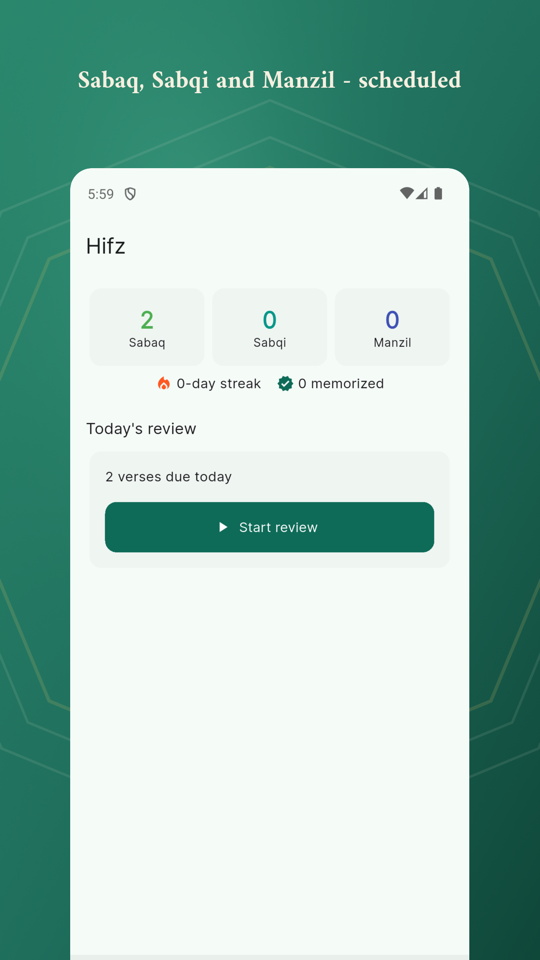
The daily queue keeps the madrasa's priority: Manzil verses that are due, then the verses in Sabqi, then up to 5 new Sabaq verses. The Hifz home shows bucket counts, a day streak, a memorised count and how many verses are due today, and a Weak spots list shows the 8 verses with the most logged stumbles. Progress is stored on the device first, so reviews work offline.
Beta limits, plainly
The reader holds the complete verified Qur'an, so the scheduler can work with any verse you add. Rusukh's Sabqi is defined by review gap rather than calendar week, and the app doesn't listen to your recitation. To try the full cycle on one long verse, see our step-by-step plan for memorising Ayat al-Kursi.
Frequently asked questions
What is manzil in hifz?
Manzil is the long-term revision of everything memorised before your recent lessons. Older portions are recited on a rotation, a set amount each day, so each one comes back regularly. Some classes call it dhor. The word also names the seven portions the Qur'an is traditionally divided into for reciting in a week.
What is the meaning of sabqi?
Sabqi is recent revision: roughly the last week or more of lessons, recited daily until they settle. The teacher sets how far back it reaches, and it usually grows as you memorise more. After that, those lessons move into manzil.
How much sabaq, sabqi and manzil should I do each day?
There is no single number. Teachers size each part for the student, and many hold back new sabaq when revision is weak. Ask your teacher to set your portions, and scale back the new lesson if revision starts to slip.
Can an app replace a hifz teacher?
No. An app can track what is due and where you stumble, but it cannot hear your recitation, correct your pronunciation or judge when you are ready for more. Use it as a revision aid alongside a teacher.
What should I do if I have forgotten parts of my hifz?
Treat the weak portions as sabqi again: recite them daily, from memory first, until they are steady, then return them to your manzil rotation, and tell your teacher. If you are worried about what forgetting means religiously, take that question to a scholar rather than an app. This is a study aid. For a personal ruling, consult a qualified scholar or your imam.