
An Islamic AI chatbot can be a useful study partner, but only if you can check what it tells you. Before you trust an answer, run six checks. Does it give an exact surah:ayah reference? Does it name the translation it quotes? Can you see the source text? Does it show a hadith's grade and who graded it? Does it defer to a scholar on rulings? Can you report a mistake? A tool that passes all six lets you verify it in minutes. One that fails is asking for trust it hasn't earned.
Why general chatbots slip on sacred text
Large language models write by predicting plausible next words. That makes them fluent, and it is also why they sometimes produce text that sounds right but isn't. NIST's Generative AI Profile (NIST AI 600-1, July 2024) calls this "confabulation": "confidently stated but erroneous or false content," better known as hallucinations.
Religious text is especially exposed. A Qur'an reference has a predictable shape (surah, colon, āyah), and so does a hadith citation (collection and number). A model can reproduce the shape without the substance:
- a real reference attached to wording that isn't in that verse;
- a paraphrase placed inside quotation marks as if it were a translation;
- a saying attributed to the Prophet ﷺ with the wrong collection or number, or a grade the tool made up;
- a confident yes or no on a question of fiqh where scholars differ.
This applies whether you use a general chatbot or an AI Qur'an app. What matters is whether the tool generates sacred text or retrieves it, and that difference shows from the outside.
The six checks for any Islamic AI chatbot, at a glance
| Check | Look for | Verify it yourself |
|---|---|---|
| 1. Exact reference | A surah:ayah number for every verse quoted | Open the verse on quran.com. Is the wording there? |
| 2. Named translation | The translator, such as Saheeh International | Switch to that translation and compare |
| 3. Visible source | The passage itself, one tap away | Each claim should appear in the passage |
| 4. Attributed grade | A hadith's grade and who graded it | Compare it on sunnah.com |
| 5. Defers on rulings | Sources, differences noted, a pointer to a scholar | Ask a "can I…" question |
| 6. Report button | A flag on the answer and its sources | Find it before you need it |
Checks 1–2: An exact reference and a named translation
Check 1: Is there an exact reference?
"The Qur'an says…" is not a citation. A trustworthy answer gives the surah and āyah for every verse it relies on, such as al-Baqarah 2:255 for Ayat al-Kursi. No number, or a whole surah cited for one phrase, leaves you nothing to check.
How to verify: open the reference on quran.com (quran.com/2/255 goes straight to that verse) and confirm the quoted wording is there. Watch for references that can't exist: al-Baqarah has 286 āyāt, so 2:300 is invented on its face.
Check 2: Is the translation named?
Translators word the same āyah differently, so a quote with no translator's name can't be checked.
How to verify: look for a named translator such as Saheeh International, Abdel Haleem or Pickthall. quran.com offers many named translations, so switch to the one the answer names and compare word for word. If the words match no translation, treat the "quote" as a summary at best.

Checks 3–4: Visible sources, and grades shown as data
Check 3: Can you see the source itself?
A name-drop is not a source. "According to Bukhari" or "scholars agree" gives you nothing to open. A trustworthy tool puts the passage it relied on beside the answer, ideally numbered so each claim points at a specific passage.
How to verify: read the source, then reread the answer. Every claim should trace back to the passage.
Check 4: Are hadith grades shown, and whose are they?
Hadith scholars classify narrations by reliability. The best-known terms are ṣaḥīḥ (sound), ḥasan (good) and ḍaʿīf (weak), as Britannica's overview of ʿilm al-ḥadīth explains. A grade is a scholar's judgment, and scholars sometimes grade the same narration differently.
So the grade should travel with the text, along with who gave it. sunnah.com, for example, displays grade decisions by Shaykh al-Albani and by Darussalam for narrations outside Ṣaḥīḥ al-Bukhārī and Ṣaḥīḥ Muslim. A chatbot that declares a hadith authentic in its own voice, with no grader named, is giving you a label you can't trace.
How to verify: look the narration up by collection and number on sunnah.com, and compare the wording and the grade.
Check 5: Does it defer on rulings?
Questions like "Can I…?", "Is it halal…?" or "Does this break my fast?" are fiqh questions. The answer can depend on your circumstances and your school of thought, and the schools don't always agree.
A good tool can show the sources, note where schools differ, and point you to someone qualified, without handing you a personal verdict.
How to verify: ask a personal "can I…" question. A flat yes or no with nothing else fails this check.
A study aid, not a ruling
This is a study aid. For a personal ruling, consult a qualified scholar or your imam.

Check 6: Can you report a wrong answer?
Every tool gets something wrong eventually, and the honest ones make correction easy. Look for a report option on the answer itself, and ideally on each source it cites.
How to verify: find the report button before you need it. If it's buried in settings, most errors will never be reported.
How Rusukh answers each check, and what it can't do yet
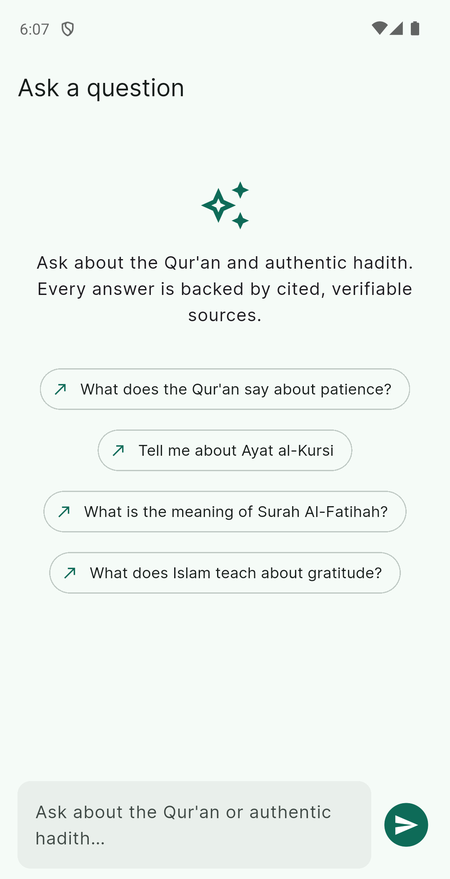
Rusukh is a Qur'an study companion, and its Ask assistant was built around these checks. Its rule is short: cite, or defer. Answers are retrieval-grounded, the model runs on the server, and it may only quote passages retrieved word for word from Rusukh's verified corpus.
- 1. Exact referenceAnswers must carry numbered citations (S1, S2…), and each one has to point to a passage that was actually retrieved. Before display, a validation gate checks each quote against the retrieved passages and confirms that every surah:ayah mentioned exists. If an answer fails twice, Ask returns a fixed message saying it couldn't find a verified source, and suggests a scholar or your imam.
- 2. Named translationEach passage records its source and retrieval date. The text came from AlQuran Cloud (Tanzil's Uthmani Arabic with Pickthall's English translation) and was never typed by hand.
- 3. Visible sourcesCitation chips open the passage in a sheet, and a Sources panel lists every passage used, with its attribution.
- 4. Grades as dataThe gate rejects any answer that states a hadith grade no source carries. Rusukh ships no hadith corpus at all, so no grade — and no hadith — appears in the app.
- 5. DeferralA scope banner reads Established, Differs by school, or Consult a scholar. Ruling-style questions ("should I", "can I", "is it halal") never show as Established, and they always carry a defer line that can't be dismissed.
- 6. Reporting"Report this answer" sits on every answer, with a Report link on each source. Reports go to a review queue.
A religious-accuracy test suite covers the gate and runs automatically on code changes, and a failure there is treated as a release blocker.
What Rusukh can't do yet
Rusukh is in private beta with partner masjids. Its offline reader holds the complete Qur'an — all 114 surahs — with Pickthall's English translation, but Ask's server-side corpus doesn't yet hold the full text, so for now most questions get the defer message. There are no hadith and no tafsir, so a question that turns on either will get it too. Ask needs an internet connection, and its answers are checked mechanically against stored sources, not reviewed by scholars. It doesn't replace your teacher or imam.
Ask sits beside an offline mushaf reader and a hifz scheduler. If you're memorizing, see our guides to sabaq, sabqi and manzil and to memorizing Ayat al-Kursi.
Frequently asked questions
Can an Islamic AI chatbot give me a fatwa?
No tool should give you a personal ruling. A good Islamic AI chatbot can show you the relevant sources and note where schools of thought differ, but a ruling depends on your circumstances and needs a qualified person. This is a study aid. For a personal ruling, consult a qualified scholar or your imam.
How do I check a Qur'an verse that an AI quoted?
Take the surah:ayah reference (for example 2:255), open that verse on quran.com, select the translation the answer names, and compare the wording. If there is no reference, no named translator, or the words don't match, don't rely on the quote.
Why do AI chatbots hallucinate Qur'an verses and hadith?
General chatbots predict likely words rather than looking up a stored source. NIST calls the result confabulation. Because references have a predictable format, a model can produce one that looks real but points to wording that isn't there.
Is a Qur'an AI assistant safe to use for study?
It can be a useful starting point if it passes the six checks above. Use it as a study aid alongside a teacher, not as an authority.